


Six Iranian protesters spoke solely to Kayhan Life who say they witnessed the brutal crackdown on mass demonstrations in Tehran, Mashhad, Isfahan and Rahijan on January eighth and ninth. They described the crackdown as a coordinated army assault on unarmed civilians, utilizing heavy weapons and coordinated forces, supposed to kill fairly than disperse crowds.
 Sit-in of bazaar shopkeepers confronting regime officers, Tehran Bazaar, January 6, 2026, Kuala Lumpur
“It was like a international nation attacking one other nation and drowning its folks in blood. It was a large-scale bloodbath,” stated a Tehran resident who took half within the demonstration. “There was no indication that the police or safety forces had been attempting to manage or deter the protesters, who had been fellow residents. What they did seemed like a superbly deliberate wartime assault, with giant quantities of army gear and a decided dedication to remove folks and pile up our bodies.”
The protests started on December 28 with a strike in Alaeddin Passage, the principle cell phone market in central Tehran, and inside days turned the most important anti-government protest within the historical past of the Islamic Republic and the bloodiest crackdown on protesters wherever on this planet within the twenty first century.
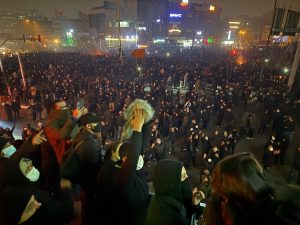 January 10, 2026, Tehran, Iran: Iranian protesters exhibit in Tehran, Iran. Reuters/
Millions rally throughout Iran after Prince Reza Pahlavi’s name for brand spanking new protests
At 10pm native time on January 8, the Islamic Republic shut down web entry nationwide and started mass killings of protesters. Various media reviews put the loss of life toll at wherever from 12,000 to greater than 20,000, however this determine can’t be independently verified, particularly given the persevering with communications disruption.
Twenty-three days into the protests, nationwide web entry was nonetheless not restored, and phone with folks inside Iran remained practically unattainable.
A protester recognized solely as Reza, who had been taking part in demonstrations within the days main as much as January 8, stated he was utterly unprepared for what he noticed in Tehran that night time.
Leather, who was getting ready to affix the demonstration round 8:30 p.m., was shocked to see the dimensions of the motion.
“We had been anticipating a much bigger crowd than the night time earlier than, but it surely wasn’t as loopy as this one,” he stated. “Our home is on the principle highway. As we had been preparing, we heard folks shouting ‘Javid Shah’ in unison outdoors. It turned clear that the group was surprisingly giant. We seemed out the window and noticed an unbelievable crowd. For quarter-hour, a line of protesters handed in entrance of our window, but it surely did not finish.”
He stated the dimensions and depth of the rallies exceeded the wave of unrest that adopted then-President Mahmoud Ahmadinejad’s re-election bid in 2009.
Reza stated footage of the January demonstrations, which was broadcast on channels world wide, could possibly be seen on satellite tv for pc tv, but it surely didn’t come near capturing the dimensions of the crowds.
Another protester in Tehran, who gave her title as Nima, stated participation seemed to be spontaneous and widespread.
“The crowd was insane,” he stated. “With no prior coordination or group, tons of of hundreds of individuals from each conceivable background, some out alone, some with family and friends, or with their youngsters, crammed the streets inside half-hour from 8 a.m. to eight:30 p.m. on January 8. It was unbelievable. Everyone was in solidarity.”
In Mashhad, Iran’s second metropolis and a middle of non secular pilgrimage within the nation’s northeast, a protester who gave his title as Ali stated town’s fundamental thoroughfare, Vakirabad Boulevard, was crowded with protesters for a number of kilometers.
“There was an inflow of individuals,” he stated. “More than 1,000,000 folks gathered in a single place, with one voice,” he stated, including that safety forces had been initially pressured to withdraw as a result of dimension of the group.
In town of Lahijan in Gilan province, close to the Caspian Sea (inhabitants: about 110,000), a protester who recognized himself as Behrouz additionally testified to the overwhelming turnout.
“There was no finish in sight to the march,” he stated. “Everyone was there, from youngsters to older women and men, chanting collectively in solidarity. Next to me, a girl over 70 was shouting slogans with the group.”
Bellows stated many individuals really feel the federal government has misplaced management. “After an hour, we felt town was within the palms of the folks,” he stated.
“I did not actually see any armed folks,” he stated. “People had been left empty-handed. Reports later got here out claiming that the protesters dedicated mass destruction. I deny that about Rahijan. Even if the trash cans had been burnt, it was a method to create a defend in opposition to gunfire by the militants. No one needed to wreck folks’s property or retailers.”
Multiple interviewees stated the group remained on the streets for 2 to a few hours, then thinned out round 11 p.m. as households left. Reza stated the decline in numbers seems to be inflicting a rise in systematic enforcement.
“Security forces had been all current, together with police, riot police, Revolutionary Guards, and armed plainclothes troopers with knives and firearms,” he stated. “They had been totally organized and coordinated. I had been to earlier protests, and this time I can say with confidence that the federal government had ready upfront a totally coordinated plan to suppress it by killing. Their intention was to not disperse; it was to kill. They gave a warning after which began taking pictures.”
He described a sample of troops firing into crowds, forcing fleeing protesters into aspect streets and alleys, and attacking smaller teams with weapons and batons.
It additionally claimed that reconnaissance drones had been used. “As small teams took shelter in alleys, lasers had been shined on folks and operatives guided by drones on bikes moved in direction of the protesters to quell them,” he stated.
Bellows stated drones have additionally been seen over Lahijan and are used as instruments of intimidation and as a way of monitoring folks working via slender streets.
In Isfahan, a metropolis in central Iran recognized for its historic bridges and boulevards, a protester who recognized herself as Bahar described what she referred to as a “wartime state of affairs” within the Charbagh and Sheikh Seydou districts. She stated she had been injured by a bullet in her leg and had prevented the hospital for her personal security.
“Injured folks had been being kidnapped on the hospital,” she stated. “Plain-clothed safety forces from the Ministry of Information and the intelligence wing of the Revolutionary Guards, fairly than common police, searched the hospital room by room, mattress by mattress, in search of protesters.”
She stated a relative handled her at dwelling as a result of her household feared detention.
Bahar stated safety forces opened fireplace on demonstrators and plainclothes males used knives, batons and pistols. “The scene was terrifying,” she stated, including that the crackdown had strengthened her resolve to proceed resisting.
Nima stated safety forces in areas west of Tehran, together with Saadeghye, Punaq and Sattar Khan, didn’t depend on tear gasoline as a lot as in previous protests, as a substitute utilizing stun grenades and reside ammunition if crowds didn’t disperse. He stated armored automobiles drove into crowds in some areas and troops chased protesters into alleys “with intent to kill.”
Several interviewees acknowledged that safety forces carried out a fast cleanup operation after the violence to destroy proof.
Bahar stated that round midday the day after the crackdown, members of the family went to the streets close to the Zayandeh River in Isfahan and reported that there was little proof of the earlier night time’s bloodshed. Bellows stated he drove round Lahijan the following morning and located the streets cleared of particles and graffiti.
“All traces of the bloody protests have been erased, like in these films the place zombies assault at night time and town seems regular within the morning,” he stated.
As data slowly unfold regardless of communication failures, residents started to be taught concerning the deadly accident close to their properties. Nima stated she later discovered {that a} younger protester had been killed in a close-by road and two extra folks had been killed a number of streets away.
Nima stated mates in Zahedan, the capital of Sistan and Baluchestan provinces in southeastern Iran, stated there have been ongoing clashes, army deployments and elevated safety throughout the day. He stated there have been armed clashes between demonstrators and safety forces in some areas of the state.
The full scale of the lifeless and injured remained unknown even to those that claimed to have witnessed the violence.
A hospital employee at a personal hospital in western Tehran, who gave his title as Shaghayeg, described overflowing emergency rooms and intense stress from safety authorities.
“The casualties and deaths had been tragic,” she stated. “Even after the Bam earthquake, we’ve not seen something like this.” She stated injured folks had been arriving in droves, emergency room flooring had been coated in blood, and hospitals had been combating a scarcity of workers, working rooms and blood provides.
He stated safety personnel yelled at workers and civilians to not movie or movie, after which tried to look hospital staff’ cell telephones. She stated many individuals deleted their recordings resulting from worry and coercion.
Shaghaeg stated he had circuitously witnessed our bodies being faraway from his hospital, however stated colleagues reported that at one other hospital in western Tehran, workers disabling surveillance cameras took in not solely the our bodies of the lifeless but in addition injured sufferers, together with these in casts and people receiving stitches.
She additionally stated that on January 9, safety authorities put stress on some hospitals to refuse to confess injured protesters.
Reza spoke of added stress on his household. He stated that in change for burial permits and cash, he requested family members to signal paperwork stating that their deceased members of the family had been members of the Basij militia, however most households refused this supply.
Reza additionally argued that the introduced timing of the protests – requires rallies on the similar time on 4 consecutive nights – made it simpler for safety forces to arrange ambush techniques, resembling putting snipers on rooftops and deploying troops to areas the place analysts deemed crowds more likely to collect.