


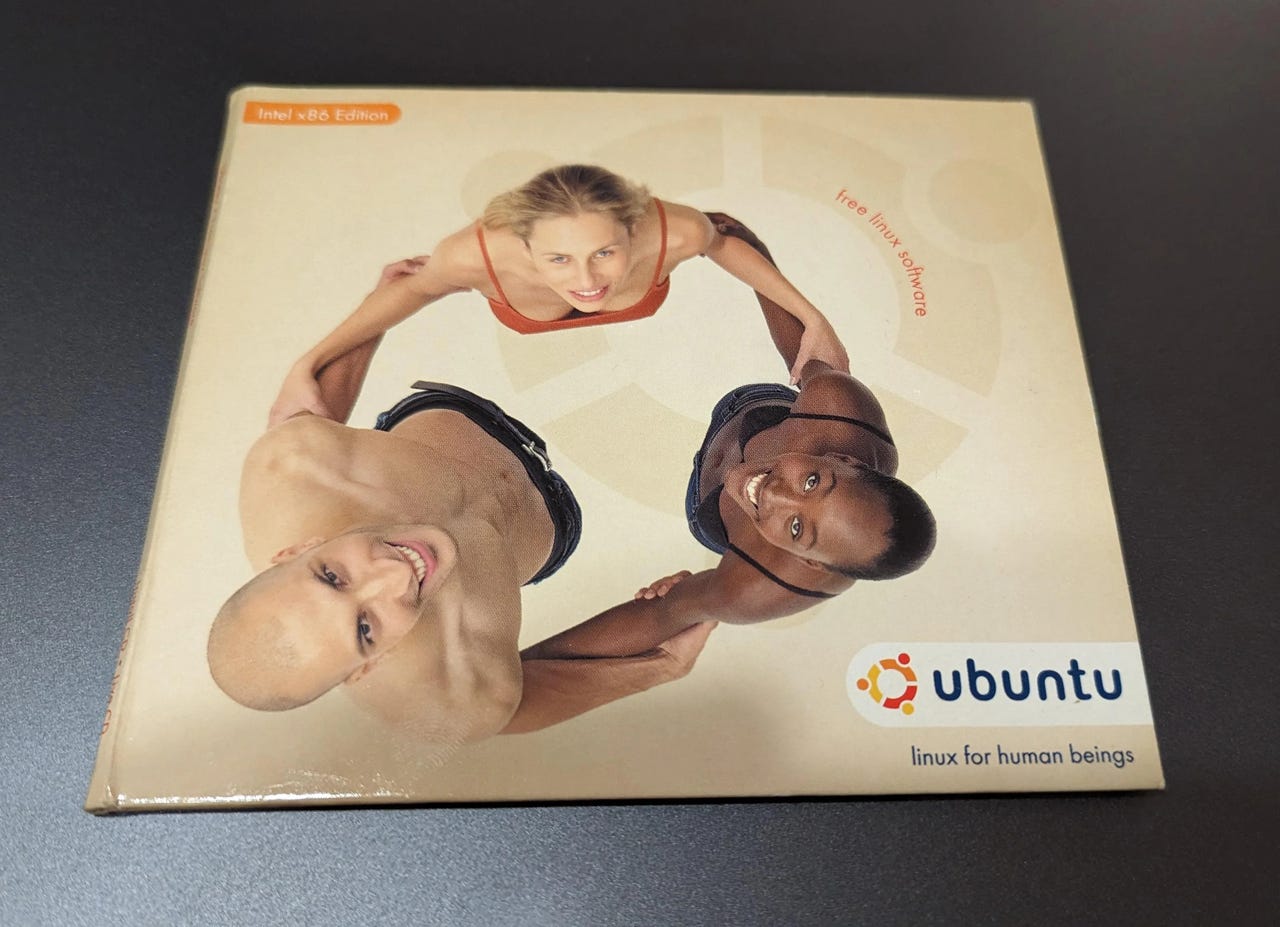
You can obtain the primary model of Ubuntu Linux or have a launch CD mailed to you totally free.
Stephen Vaughan Nichols/ZDNET
2004 was already an eventful 12 months for Linux. As I reported on the time, SCO was making an attempt to place Linux out of enterprise. Red Hat was abandoning its Linux end-user fan base for enterprise clients by ending Red Hat Linux 9 and launching Red Hat Enterprise Linux (RHEL) for enterprise. Oh, and South African tech billionaire and astronaut Mark Shuttleworth began Canonical, the mother or father firm of Ubuntu Linux.
Little did I, or anybody else, think about that Canonical would turn out to be one of many world’s main Linux firms.
Related article: Best Linux distributions for learners: Tested by consultants
From the start, Canonical’s objective has been to help and share free and open supply software program. In truth, the title of its flagship working system, Ubuntu, comes from the Zulu phrases “Umuntu ngumuntu ngabantu.” Its fashionable which means outdoors of Linux circles comes from the late Archbishop Desmond Tutu. In his guide, No Future Without Forgiveness, he mentioned that individuals utilizing Ubuntu are “open, accessible to others, and affirming of others.”
Sound acquainted? When Shuttleworth introduced the discharge of his Ubuntu 4.10 Warty Warthog, the primary model of Ubuntu, he wrote:
“Ubuntu” is an historical African phrase which means “humanity in the direction of others” and we expect it is an ideal title for an open supply neighborhood undertaking. In that spirit, we welcome you to hitch our neighborhood, contribute, and share Ubuntu.
In different phrases, as Ubuntu’s unique motto says, it is “Linux for people.”
Back then, as now, Ubuntu was primarily based on Debian Linux. Unlike Debian, which missed deadlines it might by no means meet, Ubuntu was set to replace to the most recent desktop, kernel, and infrastructure with new releases each six months. Canonical has maintained that tempo for 20 years, apart from the Ubuntu 6.06 launch.
Canonical’s mission has been daring from the start. The objective was to create an working system that was as feature-rich, user-friendly, and accessible as any proprietary working system. Released in October 2004, Ubuntu Linux rapidly grew to become synonymous with ease of use, stability, and safety, bridging the hole between the facility of Linux and the convenience of use demanded by finish customers.
Related article: Ubuntu 24.04: Same as earlier than, however with 5 large enhancements
Canonical’s early years had been characterised by speedy innovation and neighborhood constructing. The Ubuntu neighborhood, a vibrant and passionate group of builders and customers, was on the coronary heart of the undertaking. Forums, Wikis, and IRC channels had been buzzing with exercise as folks from all around the world got here collectively to contribute code, report bugs, create documentation, and help one another.
Over the years, this community-centered strategy has developed. While Ubuntu stays an end-user-friendly distribution, it’s the solely Linux distribution from a significant vendor with robust help for desktop Linux (to maintain the lights on). Ubuntu is at the moment most used as a cloud, server, and Internet of Things. (IoT) Operating System.
Canonical has additionally tried to affect the course of Linux, with combined success. For instance, in 2011 Canonical launched a brand new Linux desktop, Unity, because the default desktop. The concept was to create a graphical interface that may very well be used not solely on Linux desktops, but additionally on smartphones and tablets.
For 4 years, Unity has made Ubuntu easy sufficient for youths to make use of. Click on the app to launch it instantly.
Screenshot by Steven Vaughan-Nichols/ZDNET
Meanwhile, in 2016, Ubuntu Snap, a containerized method to set up software program, was launched and, together with rival Red Hat’s Flatpak, helped Linux acquire desktop reputation. Both make it a lot simpler for software program distributors to ship packages to Linux desktops and assist give customers extra alternative of functions.
Also: Ubuntu Unity revives Canonical’s creativity and brings again probably the greatest UIs
Canonical’s affect extends past the desktop. For instance, Ubuntu Linux is the primary cloud working system. Ubuntu began as a neighborhood desktop distribution, however has now turn out to be a significant pressure in enterprise Linux.
Looking forward, I anticipate Canonical to finally go public. Unusually for a know-how firm, Canonical doesn’t have the monetary must subject an IPO. Mr. Shuttleworth managed to start out the corporate along with his personal funds. As Shuttleworth mentioned in a 2022 interview, Canonical does not want the cash. Rather, the corporate is looking for a steadiness between “sustaining what we expect folks actually love about Ubuntu and Canonical, and persevering with to construct on the accountability we at the moment imagine we’ve got within the international know-how market.” I’m looking for out.”
Today, as Canonical celebrates its twentieth anniversary, Ubuntu Linux powers hundreds of thousands of desktops, servers, and the cloud. Canonical’s journey is not over but. I anticipate the following 20 years to be as progressive and profitable as the primary 20 years.