


Successful reforestation retains japanese U.S. cool
Parts of the southeastern and central United States aren’t warming as a lot as different elements of the nation.Reforestation could also be partly accountable for this ‘warming gap’
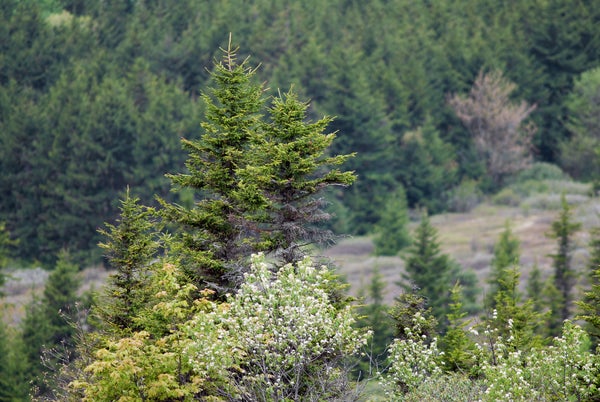
The Dolly Sods Wilderness, now a protected space of the Monongahela National Forest within the Allegheny Mountains of West Virginia, was logged within the late nineteenth and early twentieth centuries.
credit score:
John M. Chase/Getty Images
Even as local weather change heats up the United States, some japanese states are mysteriously staying cool. This is a thriller that’s not fully solved, however researchers now consider that reforestation could also be a part of the rationale.
At the identical time, the burning of fossil fuels started to heat temperatures throughout the United States, besides in a lot of the Southeast and Central areas. There are a number of theories as to why these areas of decrease common temperatures, known as “warming holes,” exist. For instance, agricultural irrigation can decrease temperatures by way of evaporative cooling, the place aerosols (tiny particles of air pollution) replicate daylight. But Kim Novick, an ecologist at Indiana University, wished to know if reforestation is perhaps enjoying a job, and wished to search out out the place reforestation and the U.S. warming gap overlap: Louisiana. They checked out a roughly triangular space stretching from the state to Florida and north to Pennsylvania. Novick and her colleagues not too long ago described how warming holes and forest regeneration could also be linked in a examine revealed within the journal Earth’s Future.
About supporting science journalism
“This paper is admittedly concerning the adaptability of reforestation,” Novick says. Many research have investigated how bushes might help mitigate local weather change by storing carbon, however this new examine highlights how forests can even present cooling. she says.
Novick and his colleagues used satellite tv for pc, historic temperature, and climate station information to check how floor and air temperatures change between forested areas and non-forested areas similar to grasslands and fields. Temperature was an essential issue to think about as a result of it helps show that there’s certainly a cooling impact, Novick mentioned. That’s as a result of air strikes, that means chilly air can drift from the forest ecosystem into surrounding areas.
The researchers then checked out how temperatures modified as forests regenerated between 1900 and 2010.
Researchers discovered that by the top of the twentieth century, temperatures on the most popular days in reforested areas have been as much as 1.8 levels Fahrenheit (1 diploma Celsius) decrease than in non-forested neighborhoods. Surface temperatures within the tree cover have been even milder, dropping 1.8 to three.6 levels Celsius (1 to 2 levels Celsius) per yr in comparison with the encompassing non-forested land. The cooling impact is most noticeable throughout noon in the summertime, when people want probably the most cooling, when floor temperatures drop by as much as 9 levels Celsius (5 levels Celsius).
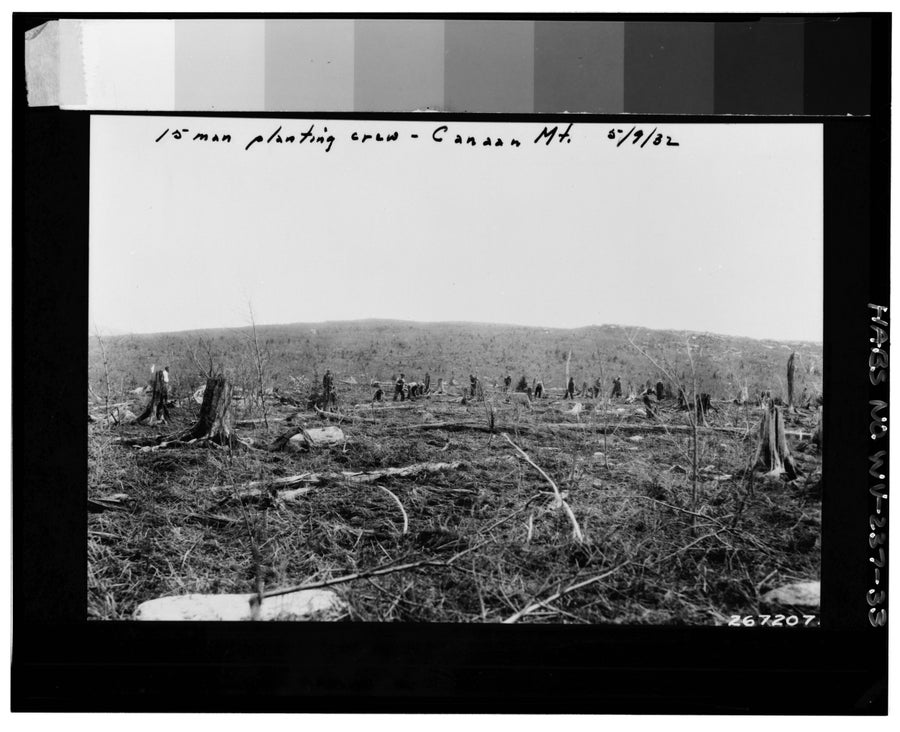
Historic 1932 picture of 15 tree staff in Tucker County, West Virginia.
Credit: Library of Congress, Prints and Photographs Division, HABS WVA, 47-PARS.V, 1–33
However, this end result doesn’t imply that bushes ought to be planted in all places. In deserts, the place there are few bushes to start with, and in boreal forests, which expertise snow a lot of the yr, growing the variety of bushes might result in additional warming. Tree cowl is darker than snow, which reduces the albedo (a measure of daylight mirrored into house) of snow-covered areas. However, in additional temperate forests, similar to these of the japanese United States, the cooling results of transpiration and environment friendly warmth switch outweigh the discount in albedo.
Moreover, the advantages will seemingly solely come from true reforestation, or encouraging the regrowth of bushes in traditionally forested areas. Reforestation (planting forests the place nothing has grown earlier than) can have detrimental results on the setting. For instance, planting bushes in dry climates can cut back the out there water provide.
“This does not work in all places,” says Susan Cook-Patton, senior forest restoration scientist on the Nature Conservancy. “But in wetter temperate and tropical places, it is a promising possibility.” One scenario, he mentioned, is when burned areas aren’t naturally regenerating. The greatest place for this strategy could be in western states like Colorado, the place large wildfires have worn out hundreds of acres of forest. Neither Cook-Patton nor Hall have been concerned within the new analysis.